Glass Frogs: Centrolenidae - Physical Characteristics, Habitat, Behavior And Reproduction, Glass Frogs And People, Conservation Status, Lynch's Cochran Frog (cochranella Ignota): Species Accounts - GEOGRAPHIC RANGE, DIET
america south north giant
Glass frogs can be found in North, Central, and South America. In North America, they only live in southern Mexico. Many species are found throughout Central America and in many parts of South America as far south as southern Brazil and northern Argentina.
Although little research has been done on their food habits, scientists think these small frogs probably mainly eat tiny insects. The large Pacific giant glass frog, however, can and does consume larger prey, including fishes and other frogs.
Additional Topics
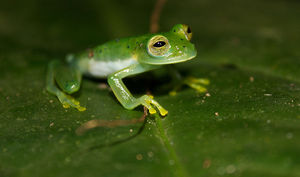
In many of the species of glass frogs, the beating heart, other working organs, blood vessels, and the bones inside are clearly visible through their see-through, or transparent, undersides. Even from the top in many species, the frogs' bodies have the look of frosted glass and sometimes provide a glimpse of the animals' inner workings. In fact, the descriptions of some species inclu…
Glass frogs are mainly land species that live in humid mountain forests. Lower on the mountains where the weather is warm, these forests are called rainforests. In colder areas higher up mountainsides, they are called cloud forests. Both areas get a good deal of rain and are very humid. Most of the glass frogs live among trees and plants that line streams. Their tadpoles live and grow in slow-movi…
Glass frogs are usually active at night. This, combined with their transparent bodies, makes them very difficult to spot for people or for predators. A flashlight shown on a glass frog at night reveals little of the frog except its large eyes and a dark smudge where the skull is. During the daylight, the frogs hide among the leaves. Since the rainforest and cloud forests are so full of plants and …
Of the 134 species in this family, the World Conservation Union (IUCN) considers sixty to be at risk, and another forty-nine to be Data Deficient, which means too little information is available to make a judgment about the threat of extinction. Of the sixty at-risk species, six are Critically Endangered and face an extremely high risk of extinction in the wild. These include Centrolene ballux, Ce…
Physical characteristics: Unlike most glass frogs, Lynch's Cochran frog is not green. This small frog is usually tan, although it is sometimes greenish brown, and has small, orange- or yellow-centered black spots on its back, head, and legs. Its body and all four legs are thin. The back legs are quite long and have webbed toes. The toes on both the front and back legs end in large, round pa…
Physical characteristics: Also known as the reticulated glass frog, the La Palma glass frog's head and smooth back are yellow or slightly orange yellow with a net pattern that is green with dark spots. The net pattern forms a series of circles. Looked at another way, the back appears green with large yellow to slightly orange yellow spots. The legs have the same colors and pattern, and the …
Physical characteristics: The Pacific giant glass frog is the largest species in this family. The typical glass frog is about an inch (2.54 centimeters) long from snout to rump, but the Pacific giant glass frog is about three times as large. Females can reach 2.4 to 2.9 inches (6.09 to 7.36 centimeters) in length, while males can grow to 2.8 to 3.2 inches (7.1 to 8.1 centimeters) long. The Pacific…
Citing this material
Please include a link to this page if you have found this material useful for research or writing a related article. Content on this website is from high-quality, licensed material originally published in print form. You can always be sure you're reading unbiased, factual, and accurate information.
Highlight the text below, right-click, and select “copy”. Paste the link into your website, email, or any other HTML document.
User Comments
over 1 year ago
emily paterson
This website does not give enough info you need more so if wikipedia and google do get shut down and we are researching this we have a decent website to go to
over 3 years ago
what is the lifespan and gestation period of the glass frog because i need it for a enviromental science project.
over 3 years ago
what is the description and characteristics of the ecosystems they live in im doing a report and its bugging the crap out of me
about 5 years ago
well how long is there life span cause i need a essay on it and that is one o the qustions!!!
about 5 years ago
I need to know what their body covering is!! I am doing a report on the frickin' creatures!
over 1 year ago
Kendra
This was a very informational and helpful along with reliable website.
over 1 year ago
I have to do a oral report and this
about 1 month ago
I am really thanks a lot for display the nice info that to utilize the great technology in this blog.
about 1 month ago
This is very much enjoyed for using the various topics are visible in this website
about 1 month ago
Thanks a lot for sharing the nice appreciate for providing the different info in this blog.
about 1 month ago
I am really admired for the great approach is visible in this blog and beautiful info that is very helpful for me.
about 1 month ago
Thanks a lot for providing the amazing services and using the writing the unique articles in this website.
5 days ago
TROLLINA
I HEART RADIOS! SON OF A HOLY MACKEREL!!!!!!!!!!!!!!!!.....and Black Butler.....
23 days ago
booooooooooooooooooooooooooooooooooooooooooooooooooooooooooooooooooooooooooooooooooooooooooooooooooooooooooooooooooooooooooooooooooooooooooooooooooooooooooooooooooooooooooooooooooooooooooooooooooooooooooooooooooooooooooooooooooooooooooooooooooooooooooooooooooooooooooooooooooooooooooooooooooooooooooooooooooooooooooooooooooooooooooooooooooooooooooookkkkkkkkkkkkkkkkkkkkkkkkkkkkkkkkkkkkkkkkkkkkkkkkkkkkkkkkkkkkkkkkkkkkkkkkkkkkkkkooooooooooooooooooooooooooooooooooooooooooooooooooooooooooooooooooooooooooooooooooooooooooooooooooooooooooooooooooooooooooooooooooooooooooooooooooooooooooooooooooooooooooooooooooooooooooooooooooooooooo
23 days ago
booooooooooooooooooooooooooooooooooooooooooooooooooooooooooooooooooooooooooooooooooooooooooooooooooooooooooooooooooooooooooooooooooooooooooooooooooooooooooooooooooooooooooooooooooooooooooooooooooooooooooooooooooooooooooooooooooooooooooooooooooooooooooooooooooooooooooooooooooooooooooooooooooooooooooooooooooooooooooooooooooooooooooooooooooooooooooookkkkkkkkkkkkkkkkkkkkkkkkkkkkkkkkkkkkkkkkkkkkkkkkkkkkkkkkkkkkkkkkkkkkkkkkkkkkkkkooooooooooooooooooooooooooooooooooooooooooooooooooooooooooooooooooooooooooooooooooooooooooooooooooooooooooooooooooooooooooooooooooooooooooooooooooooooooooooooooooooooooooooooooooooooooooooooooooooooooo
23 days ago
booooooooooooooooooooooooooooooooooooooooooooooooooooooooooooooooooooooooooooooooooooooooooooooooooooooooooooooooooooooooooooooooooooooooooooooooooooooooooooooooooooooooooooooooooooooooooooooooooooooooooooooooooooooooooooooooooooooooooooooooooooooooooooooooooooooooooooooooooooooooooooooooooooooooooooooooooooooooooooooooooooooooooooooooooooooooooookkkkkkkkkkkkkkkkkkkkkkkkkkkkkkkkkkkkkkkkkkkkkkkkkkkkkkkkkkkkkkkkkkkkkkkkkkkkkkkooooooooooooooooooooooooooooooooooooooooooooooooooooooooooooooooooooooooooooooooooooooooooooooooooooooooooooooooooooooooooooooooooooooooooooooooooooooooooooooooooooooooooooooooooooooooooooooooooooooooo
23 days ago
booooooooooooooooooooooooooooooooooooooooooooooooooooooooooooooooooooooooooooooooooooooooooooooooooooooooooooooooooooooooooooooooooooooooooooooooooooooooooooooooooooooooooooooooooooooooooooooooooooooooooooooooooooooooooooooooooooooooooooooooooooooooooooooooooooooooooooooooooooooooooooooooooooooooooooooooooooooooooooooooooooooooooooooooooooooooooookkkkkkkkkkkkkkkkkkkkkkkkkkkkkkkkkkkkkkkkkkkkkkkkkkkkkkkkkkkkkkkkkkkkkkkkkkkkkkkooooooooooooooooooooooooooooooooooooooooooooooooooooooooooooooooooooooooooooooooooooooooooooooooooooooooooooooooooooooooooooooooooooooooooooooooooooooooooooooooooooooooooooooooooooooooooooooooooooooooo