Jellyfish: Scyphozoa - Physical Characteristics, Behavior And Reproduction, Jellyfish And People, Sea Nettle (chrysaora Quinquecirrha): Species Accounts - GEOGRAPHIC RANGE, HABITAT, DIET, CONSERVATION STATUS
animals live water plants
Jellyfish live in all the oceans of the world.
Jellyfish medusae live in seawater from shore areas exposed at low tide to the very deep ocean. The polyps are attached to hard surfaces, such as rocks, shells, and plants, at various depths.
Jellyfish eat plankton, which is microscopic plants and animals drifting in water; fish eggs and larvae (LAR-vee), or young animals that must change form before becoming adults; other jellies; and small crustaceans (krus-TAY-shuns), which are water-dwelling animals that have jointed legs and a hard shell but no backbone.
Jellyfish are not threatened or endangered.
Additional Topics
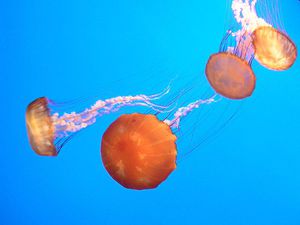
Jellyfish have one or both of two body forms: bottom-dwelling polyp and freely swimming medusa. The medusa (mi-DOO-suh) is the jelly-like, usually bell- or umbrella-shaped, usually tentacled form. The polyp (PAH-luhp) consists of a tubular sac with a mouth and tentacles on top. Polyps are less than one-eighth inch (4 millimeters) long. Medusae (mi-DOO-see, the plural of medusa) can be as large as …
The most noticeable behavior of jellyfish is rhythmic pulsing of the swimming bell, which moves them through the water. The swimming pulsations are coordinated by nerve centers around the edge of the bell. Medusae can sense light and dark and can determine their orientation in the water. Some jellyfish swim continuously. This feature is important for oxygen exchange, which occurs over the entire b…
Physical characteristics: The swimming bell of sea nettles can reach 10 inches (25 centimeters) in diameter, but most sea nettles are much smaller. The edges of the swimming bell are petal shaped. One large tentacle emerges from between the petals, and twice as many small tentacles arise from beneath the petals. Eight sense structures are present in alternate spaces between the petals. The narrow …
Physical characteristics: The swimming bell of a nightlight jellyfish usually is less than 3.5 inches (9 centimeters) in diameter. It has a bumpy surface caused by clusters of stinging cells, which give a purple or yellowish color to the bell. Four long oral arms and eight long tentacles alternate with eight sense structures in the spaces between folds on the bell. There is no polyp stage. Geograp…
Physical characteristics: The medusae of thimble jellies are only 1 inch (2.5 centimeters) high. These jellies are shaped like a thimble, which is a hard cap some people put on a fingertip while sewing. There is a shallow groove near the top of the bell. Thimble jellies have eight very short tentacles and eight sense structures alternating between sixteen folds at the bell margin. The outside of t…
Citing this material
Please include a link to this page if you have found this material useful for research or writing a related article. Content on this website is from high-quality, licensed material originally published in print form. You can always be sure you're reading unbiased, factual, and accurate information.
Highlight the text below, right-click, and select “copy”. Paste the link into your website, email, or any other HTML document.
User Comments
about 1 year ago
thanx i needed this 4 a zoology project
over 2 years ago
Hello,
Im looking at Cassiopea jellyfish eating habits and trying to destinguish the difference form other Scyphozoans. My thoughts so far is the simbiance with plankton any other thoughts? Also do you know of any evidence of Mycorrhizal Simbisis supporting the relationship just curious on your thoughts I will return something intresting to you if I uncover anything...Thank you
almost 5 years ago
I really liked the info. that I found here, and it really helped me finish writing a report.
almost 5 years ago
This is great info for assignments!
about 5 years ago
Great info needed for project