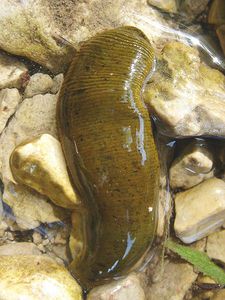
Leeches: Hirudinea - Physical Characteristics, Habitat, Diet, Behavior And Reproduction, Leeches And People, North American Medicinal Leech (macrobdella Decora): Species Accounts - GEOGRAPHIC RANGE, CONSERVATION STATUS
threatened risk
Leeches live on all continents except Antarctica.
One species of leech, the European medicinal leech, is listed by the World Conservation Union (IUCN) as Lower Risk, or at risk of becoming threatened with extinction in the future. They are threatened due to habitat loss and over-collecting. Other species with limited distributions may also be threatened.
Additional Topics
Most leeches are flattened from top to bottom and measure
0.196 to 0.787 inches (5 to 20 millimeters) in length. The longest species may reach 17.72 inches (450 millimeters). Leeches have eyespots on the head that are able to detect movement from contrasting patterns of light and shadow. The mouth is located underneath the head and is surrounded by a sucker. The sucker helps draw blood and other…
Leeches are all carnivores (KAR-nih-vorz) and feed on the flesh or fluids of other animals. Some species feed only on the blood of their prey. Many leeches are predators that ambush a wide variety of invertebrates (in-VER-teh-brehts), animals without backbones. Prey includes insects, earthworms and their relatives, beach hoppers, snails, and freshwater clams. Predatory leeches swallow their prey w…
Many leeches swim through the water with snakelike motions. They release their grip with the tail sucker and push off from a rock or plant, before wriggling their body back and forth. Species living on land move along the ground like an inchworm, stretching and shortening their bodies by using the suckers on both ends. Leeches must mate to reproduce. Mating occurs when a leech attaches a sperm pac…
Leeches were used in the 1700s and 1800s to treat all kinds of ailments, from headaches to being overweight. It was highly unlikely that any of these uses was successful. Today, leeches are used to treat tiny blood clots that form after surgery. The anti-clotting properties of their saliva may also be useful for treating heart disease, possibly even cancer. Aquatic leeches are used to measure envi…
Physical characteristics: The North American medicinal leech grows up to 3.9 inches (100 millimeters) long and 0.39 inches (10 millimeters) wide. The upper surface of the body is olive with a row of orange spots down the middle. The underside is orange. An arch of ten eyes is arranged in five pairs. Each of the three jaws has very fine small teeth. Geographic range: This species is found in Easter…
Physical characteristics: Possibly the largest freshwater leech, the giant Amazonian leech can grow up to 17.72 inches (450 millimeters) long and 3.93 inches (100 millimeters) wide. Adults are dark gray-brown. Younger individuals have a broken stripe down their backs and patches of color on every third body segment. They have only one pair of eyes. Geographic range: They live from the mouth of the…
Citing this material
Please include a link to this page if you have found this material useful for research or writing a related article. Content on this website is from high-quality, licensed material originally published in print form. You can always be sure you're reading unbiased, factual, and accurate information.
Highlight the text below, right-click, and select “copy”. Paste the link into your website, email, or any other HTML document.
User Comments
about 2 years ago
kjafsnfcjnnv;kld
about 2 years ago
kjafsnfcjnnv;kld
about 2 years ago
kjafsnfcjnnv;kld
3 months ago
I found the perfect place for my needs. Contains wonderful and useful messages. I have read most of them and has a lot of them. To me, he's doing the great work.